


Switching to a Toyota electric vehicle (EV) in Hollywood, FL in 2026 can trim your driving costs, especially as gas prices continue to fluctuate. Below we break down the factors that will affect real-world savings in 2026: projected gas trends, local electricity rates, maintenance differences, and how people drive around town.

Switching to a Toyota electric vehicle (EV) in Hollywood, FL in 2026 can trim your driving costs — especially as gas prices continue to fluctuate. Below we break down the factors that will affect real-world savings in 2026: projected gas trends, local electricity rates, maintenance differences, and how people drive around town. With that context, you’ll be able to estimate savings, learn which Toyota EV models are expected to be available nearby, review financing options, and find local service centers everything you need to weigh the benefits of going electric in South Florida in 2026.
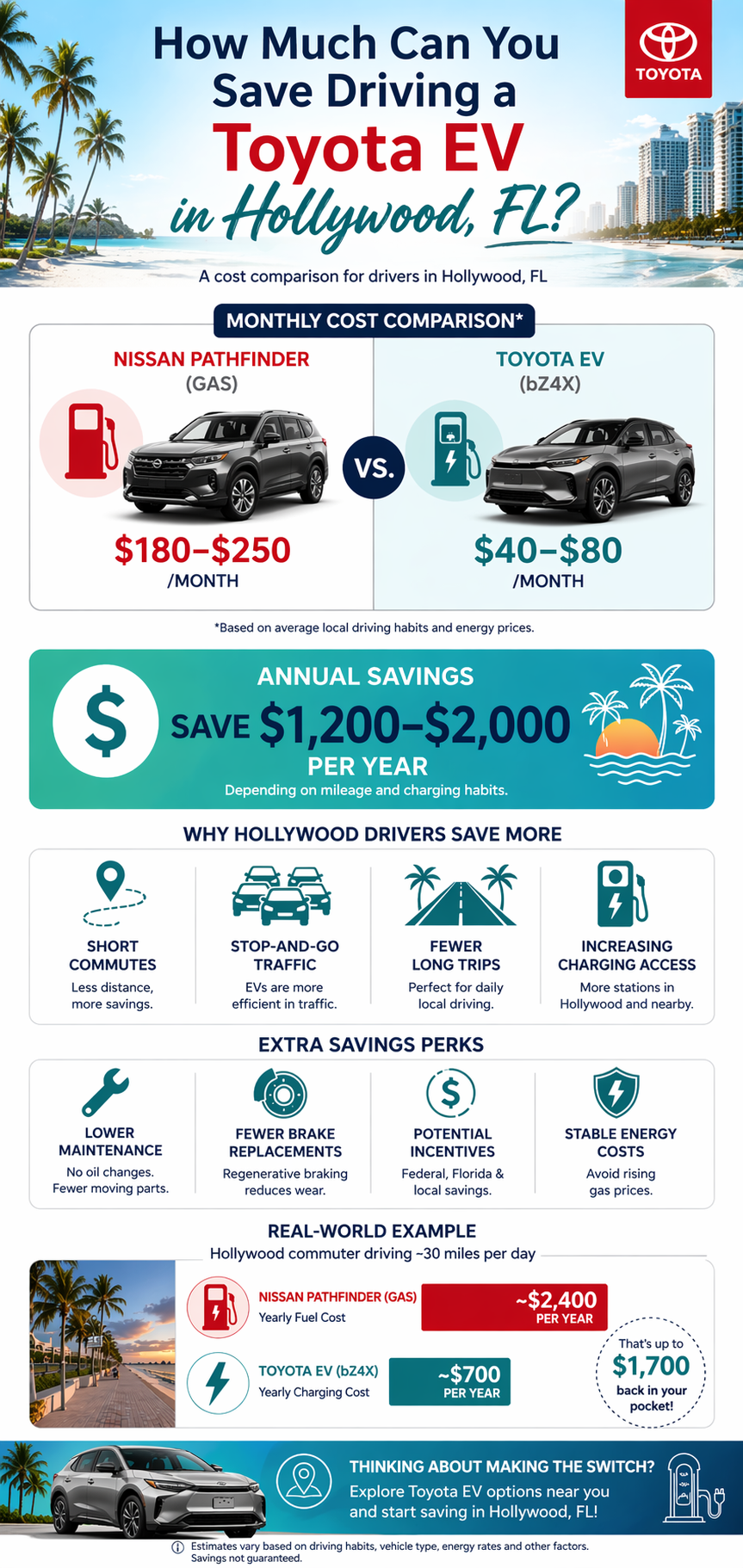
Gas prices in Hollywood, FL have been volatile in recent years, and projections for 2026 suggest that prices will continue to be influenced by global oil markets, supply chain factors, and economic conditions. As gas prices are expected to remain relatively high, many drivers are considering electric options to stabilize their monthly transportation expenses and reduce the impact of future price spikes.
Price volatility at the pump creates immediate and predictable changes to monthly budgets for drivers who rely on gasoline. Because electricity pricing tends to be steadier and utilities often publish off-peak rates, switching to an EV can convert a variable cost into one that is more manageable through scheduling and planning. For households that prioritize predictable monthly expenses, this is an important practical benefit to consider alongside environmental and performance factors.
While exact gas prices in 2026 cannot be guaranteed, forecasts indicate that prices in Hollywood may hover around or above current levels, influenced by ongoing global demand and supply dynamics. For many drivers, these sustained higher pump prices will be a key reason to consider switching to an EV.
When assessing whether to switch, look beyond the headline price: consider how many gallons you buy each month, where you typically refuel, and whether your driving includes frequent long trips. Those behavior patterns determine how sensitive your household is to changes at the pump and whether an EV will noticeably reduce monthly variability in transportation costs.
Toyota is expected to continue offering several electrified options around Hollywood in 2026, including the all-electric bZ and the plug-in Prius Prime, along with any new models introduced by then. All are built for efficiency and lower emissions, and they can deliver meaningful savings on fuel for daily drives around South Florida.
When you evaluate local inventory in 2026, consider how each model aligns with the way you use a vehicle. Plug-in hybrids provide a blend of electric operation and gasoline backup that reduces range anxiety on long trips, while full-electric models remove gasoline costs entirely and simplify the vehicle’s mechanical systems. Your ideal choice depends on commute length, parking and charging access, and long-distance driving patterns.
Toyota EVs include features that boost efficiency and lower operating costs. Regenerative braking recaptures energy to extend range and reduce brake wear. Modern battery designs give longer single-charge distances, and smart charging tools let owners schedule charges during off-peak hours to take advantage of lower electricity rates.
These features work together to reduce day-to-day operating expenses. For drivers who can consistently charge at lower-cost times and keep up with software updates and recommended maintenance, the savings can compound over the life of the vehicle.
Hybrids like the Prius Prime blend electric and gasoline power, which adds flexibility for longer trips without frequent stops to charge. Full EVs such as the bZ eliminate gasoline use entirely, which usually translates to bigger fuel and maintenance savings because they have fewer mechanical systems to service.
Your travel patterns determine which architecture makes sense: if most driving is short daily trips and you have reliable access to charging, a full EV typically maximizes operating savings. If you regularly take longer drives or do not have consistent charging access, a plug-in hybrid can act as a transitional choice that still reduces gasoline consumption while retaining the convenience of a gasoline engine for extended trips.
Explore our Toyota EV inventory or talk to our Hollywood team today.
Charging a Toyota EV in South Florida in 2026 is typically less expensive than refueling a gas car. Electricity prices can vary, but the per-mile cost of charging is usually lower than the equivalent cost of gasoline — a key part of the savings story for EV owners.
To make the most of electricity pricing, think about where and when you charge. Home charging usually offers the most consistent, low-cost option if you have access to a dedicated circuit and a Level 2 charger. Public charging networks provide convenience and fast top-ups but can be more expensive per session than home charging. Balancing home and public charging based on cost and convenience helps optimize savings.
In Hollywood, the average electricity rate for charging is projected to be around $0.14 per kilowatt-hour in 2026. Depending on battery capacity, a full charge commonly costs roughly $5 to $12 — a clear savings compared with most fill-ups at the pump.
Those sample figures show why many drivers notice a difference quickly: even with conservative charging habits, electricity expenses for daily commuting are often substantially lower than gasoline costs at current pump prices. When comparing options, factor in occasional public charging fees and any subscription or membership costs for charging networks you use regularly.
Local and state incentives can make EV ownership more affordable. Florida programs and rebates in 2026 may lower the cost of buying an EV and installing a home charger, and some utility plans offer discounted rates or programs that reduce the cost of charging during off-peak hours.
To identify applicable incentives, check with city and county government websites, your electric utility, and Toyota dealerships. Incentives can change over time, so verify current availability and eligibility requirements before budgeting. Some incentives apply to equipment purchases, while others reduce installation costs or provide ongoing rate discounts for EV charging.
One of the biggest long-term advantages of a Toyota EV is lower maintenance spending. With fewer moving parts and systems to service, EV owners often see smaller and less frequent repair bills than drivers of gas-powered cars.
Reduced maintenance does not mean no maintenance — batteries, cooling systems, electrical components, and tires still require attention. However, the elimination of many traditional powertrain maintenance items typically results in fewer scheduled services and lower cumulative parts-and-labor costs over many years of ownership.
Toyota EVs skip many components found in gas cars — no oil changes, no spark plugs, no exhaust systems — which cuts routine service needs. Regenerative braking also reduces wear on brake pads. Those design differences add up to real savings over the life of the vehicle.
Lower maintenance also means fewer unscheduled visits for common wear items associated with internal combustion engines. That contributes to more predictable ownership costs and can reduce time spent in the shop, which some owners view as an additional convenience benefit beyond direct dollar savings.
EV maintenance still relies on genuine Toyota components like battery packs and electric motor parts when service is required. Using authentic parts and recommended software updates helps preserve performance, reliability, and resale value.
When shopping for service, ask about parts sourcing and warranty coverage for any major components. Authorized service centers are trained on specific EV systems and typically have access to updated diagnostic tools and parts that align with Toyota’s specifications. This can be especially important for complex components that affect battery health and long-term reliability.
The way you drive around Hollywood — how far, how often, and in what traffic — directly affects how much you save with an EV. Knowing local patterns helps you plan charging and get the most value from an electric Toyota.
Short, frequent trips within a compact metro area are the ideal use case for economical EV ownership because they play to the strengths of electric drivetrains: high efficiency at lower speeds and frequent opportunities to recapture energy via regenerative braking. Conversely, long highway drives change the balance of costs and convenience, and drivers who do many long trips should evaluate charging access along their routes.
The average one-way commute in Hollywood is about 11 miles. That short daily distance fits comfortably within most Toyota EV ranges, meaning many commuters can go a full day or more without recharging.
For households where both drivers maintain short commutes and have overnight parking with charging access, a single daily charge can often cover routine travel. That convenience translates into fewer stops at public chargers and greater reliance on low-cost home electricity, which supports predictable, low operating costs.
Stop-and-go traffic can reduce an EV’s effective range, but regenerative braking recovers some energy during slow driving, offsetting much of the loss. Planning routes and charging stops around peak traffic can help preserve range and save money.
Another practical step is to time charging and route planning around predictable congestion patterns. If your typical schedule includes heavy traffic, consider scheduling charges during low-demand periods or using route-planning tools to minimize time in slow-moving traffic. These adjustments can both improve daily range and reduce the need for higher-cost public charging sessions.
To estimate your own savings, add up your current fuel and maintenance costs, then compare those to expected charging and service costs for an EV. Local rates, driving habits, and incentives all play a role, so a tailored estimate gives the clearest picture.
Start by listing the annual amounts you spend on gasoline and routine maintenance for your present vehicle. Next, identify the typical home electricity rate you would pay for charging, plus any public charging costs you expect. Finally, factor in lower routine maintenance needs and potential incentives to get a fuller picture of potential savings over time.
Online calculators and comparison tools can estimate savings by factoring in local electricity rates, current gas prices, and your driving patterns. These tools give personalized estimates to help you make an informed choice.
Combining these inputs produces a more realistic estimate than relying on headline averages alone. If you prefer a hands-on approach, build a simple spreadsheet with your local rates and actual driving data to run multiple scenarios (e.g., mostly home charging vs. a mix of home and public charging).
Compare purchase price, fuel or charging costs, maintenance, insurance, and expected resale value to calculate total cost of ownership. While EVs sometimes have higher upfront costs, their lower operating expenses often make them less expensive over time.
When comparing, include practical non-monetary differences that affect value for your household: time spent at service appointments, convenience of home charging, and access to incentives or special financing. For many buyers, these considerations play as important a role as pure dollar comparisons in the decision to switch.
There are a variety of financing paths for buying a Toyota EV in Hollywood in 2026 to fit different budgets — from traditional loans to special offers designed for electric vehicles.
Financing choices can shape monthly cash flow and the total interest paid over the loan term. If incentives or dealer promotions are available, combining them with favorable financing terms can reduce the effective purchase price and improve short- and long-term affordability.
Competitive local financing — lower interest rates, promotional terms, or extended payment plans — can reduce monthly payments and improve overall savings when purchasing an EV.
Evaluate offers by looking at more than just the headline monthly payment. Consider the total cost over the term, early repayment penalties, and whether promotional rates require specific qualifications. In some cases, a slightly higher monthly payment with a shorter term can reduce total interest and increase long-term savings.
Toyota of Hollywood often posts promotions for both new and pre-owned electric vehicles, from cash-back deals to low-rate financing and trade-in incentives that lower your out-of-pocket costs.
Ask the dealership for a breakdown of any current promotions and how they interact with manufacturer incentives or local rebates. Inquire whether advertised offers apply to certified pre-owned models, how trade-in values are calculated, and whether there are limited-time finance programs that provide better terms for EV purchases.
Having a trusted local service center is important to keep your Toyota EV running efficiently and protecting its value.
Authorized service centers typically have technicians trained on electric drivetrains, access to factory diagnostic tools, and immediate availability of recommended replacement parts. Building a relationship with a local service advisor familiar with Toyota EVs can make routine maintenance and unexpected repairs simpler and faster.
Toyota of Hollywood’s service team knows EVs and uses factory-recommended parts and diagnostic tools. Bringing your vehicle to an authorized center ensures work is done to Toyota standards and helps maintain warranties and long-term reliability.
Authorized centers also often provide access to service specials, maintenance plans, and software updates that keep vehicle systems current. For owners focused on long-term value and worry-free operation, these service relationships are a practical way to protect both performance and resale value.
Routine checks and timely repairs keep systems running efficiently, prevent costly breakdowns, and preserve battery health — all of which protect your long-term savings with an EV.
Regular inspections include visual checks of electrical connections, cooling systems, tires, suspension, and braking components. Staying on top of scheduled service recommended by Toyota reduces the chance of larger, more expensive repairs later and supports sustained efficiency that preserves range and performance.
To see the latest Toyota EV models and discover new vehicles, stop by our dealership today.
Driving a Toyota EV cuts your tailpipe emissions to zero and improves local air quality — a clear benefit in urban areas like Hollywood. As the power grid increasingly uses renewable energy, charging an EV becomes even cleaner, so your overall environmental impact decreases over time.
Beyond emissions, EVs reduce local noise and can decrease the broader community impact of transportation. For drivers who prioritize environmental outcomes, the combination of zero tailpipe emissions and the potential to use renewable electricity is a strong benefit of EV ownership.
Hollywood’s public charging network is growing, with stations at shopping centers, parking garages, and along main roads. Many locations offer faster chargers for quick top-ups, and some businesses even offer perks like discounted or free charging to encourage EV drivers.
To plan longer trips or manage occasional top-ups, identify reliable stations along your routes and download apps or map services that show charger availability and connector types. That planning reduces uncertainty and makes public charging a convenient complement to home charging.
Toyota EV batteries commonly last 8 to 15 years, depending on driving patterns, charging habits, and climate. Toyota builds batteries to withstand real-world conditions and typically backs them with warranties; good charging practices and regular checks help maximize battery life.
Battery longevity is influenced by charging habits, temperature exposure, and consistent maintenance. Following manufacturer guidance on charging and storing the vehicle, and using authorized service for any battery-related issues, helps preserve capacity and long-term reliability.
Yes. Qualified EV purchases may be eligible for federal tax credits, and Florida offers programs and rebates that can reduce purchase and charging setup costs. These incentives can make the switch to electric more affordable.
Because incentive programs evolve, verify current eligibility and application requirements before relying on a specific credit or rebate. Dealership finance teams and utility providers can often help identify applicable incentives and point you to the necessary paperwork.
Toyota EVs tend to hold value well, thanks to brand reputation and growing buyer demand for used EVs. Battery health, mileage, and overall condition are key resale factors, but the trend shows good residual values for well-maintained Toyota electric models.
To protect resale value, follow recommended maintenance, keep records of service, and maintain battery health through sensible charging practices. Certified pre-owned programs can also provide structured resale pathways with warranty protections that appeal to secondhand buyers.
When planning a home charger, consider charging speed (Level 2 is recommended for overnight fills), your home’s electrical capacity, and the unit’s placement for convenience. A licensed electrician can assess your setup and recommend the safest, most efficient installation.
Other practical considerations include whether your parking location is covered, the length of cable needed, and whether you want a hardwired or plug-in unit. Ask about utility rebates for charger installation and whether your utility offers EV-friendly rate plans that make overnight charging cheaper.
Charge during off-peak hours, use available incentives and rebates, keep up with recommended maintenance, and plan charging around your driving patterns. Combining smart charging habits with regular care will help you get the most savings from your Toyota EV.
Additional tactics include preferring home charging whenever practical, using regenerative braking settings efficiently, and monitoring software updates from the manufacturer that can improve efficiency. Periodically reviewing your energy bills and driving habits helps you adapt and capture ongoing savings as utility programs and vehicle features evolve.
 EN
EN ES
ES